
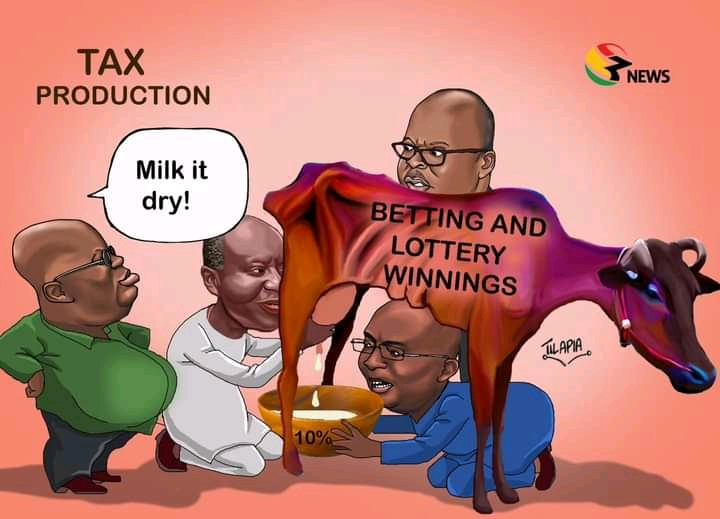
The government of Ghana, through the Ghana Revenue Authority, has placed a 10% withholding tax on bets. This follows after the coming into being of the Income Tax Amendment Bill, Excise Duty Amendment Bill and the Growth and Sustainable Bill, which was passed in parliament on March 31 as part of the conditionalities of the IMF bailout to the government.
This got the youth, especially those who engage in betting, very worried and a lot more criticising the government against the tax which say is needless.
There is however varied opinions on this tax after the GRA announced the coming into its being on August 15.
It is the considered view of the government and those who support the imposition of this tax handle that it necessary to increase the revenue of the government looking at the difficulty government has found itself as regards resources mobilization . More so, earning from betting is considered an income and therefore is subject to tax.
Others who are in favour of this 10% withholding tax on betting opine that betting among the youth will stifle their creativity and ingenuity whiles encouraging slothfulness. They posit that the youth no more develops themselves in order for them to earn decent livelihoods but depend on the betting as a quick fix to solving the problem of joblessness.
They also advance the argument that betting is detrimental to the health and welfare of these “investors” as they have come to be known in betting parlance, as betting is very addictive, which consequently can lead to frustration, and depression with their attendant challenges.
There are also those who hold a religious view. It is their believe that it is a sin to be engaged in betting. This view is mostly espoused by Christians and Moslems alike.
However, the flip side of the coin are, with vehemence, opposed to this policy.
First of all, they think betting is a source of earnings for the teeming unemployed youth of Ghana. Unemployment is one of the challenges the youth faces, if it takes betting to earn a little to cope with the harsh economic conditions of the country, then they contend the government whose duty it is to provide livelihoods must not be the one to encumber them.
Others are of the view that the economic conditions the nation has been plunged in is so dire as the levels of income of citizens have been washed away due to the rise in the cost of prices of goods and services. It is therefore out of place, they think, for a government to want to tax the income of “investors”.
There is also the political side of it. First of all, the government of the NPP whilst in opposition vowed to remove nuisance taxes, and further to move the economy from taxation to production when it got the benefits of power. And now they have done exactly the reverse and even worse on coming to power. It is this reason that some argue that the imposition of the taxes by the government means it has not demonstrated fidelity to its own words of promise when it campaigned shy away from taxation.
A view is also held that the government is wasteful in the use of the revenue and resources it generates. They believe the revenue is lost through corruption and dissipation of public funds and divulging in vulgar projects.
Succinctly, views expressed by the either sides hold water. If the policy is punitive as some would want us to believe, then I think the 20% tax on the betting companies should see a significant hike to 40%. On the other side, rather than 10% tax on the returns of bettors, the tax should affect also, the amount used in staking the bet. The stake amount and the winning amount should attract tax. That will be punitive enough.
On the issue of unemployment, this tax handle should have been dedicated solely to solving the unemployment situation which mainly is the driving force in getting the youth into betting.
 chrisk.art.blog
Leave a comment